4.9 stars from 601 Google reviews
Septic system service in Dayton, TX, explained
How your system fits together, what to watch for, and exactly what happens when we come out to pump and check your tank.
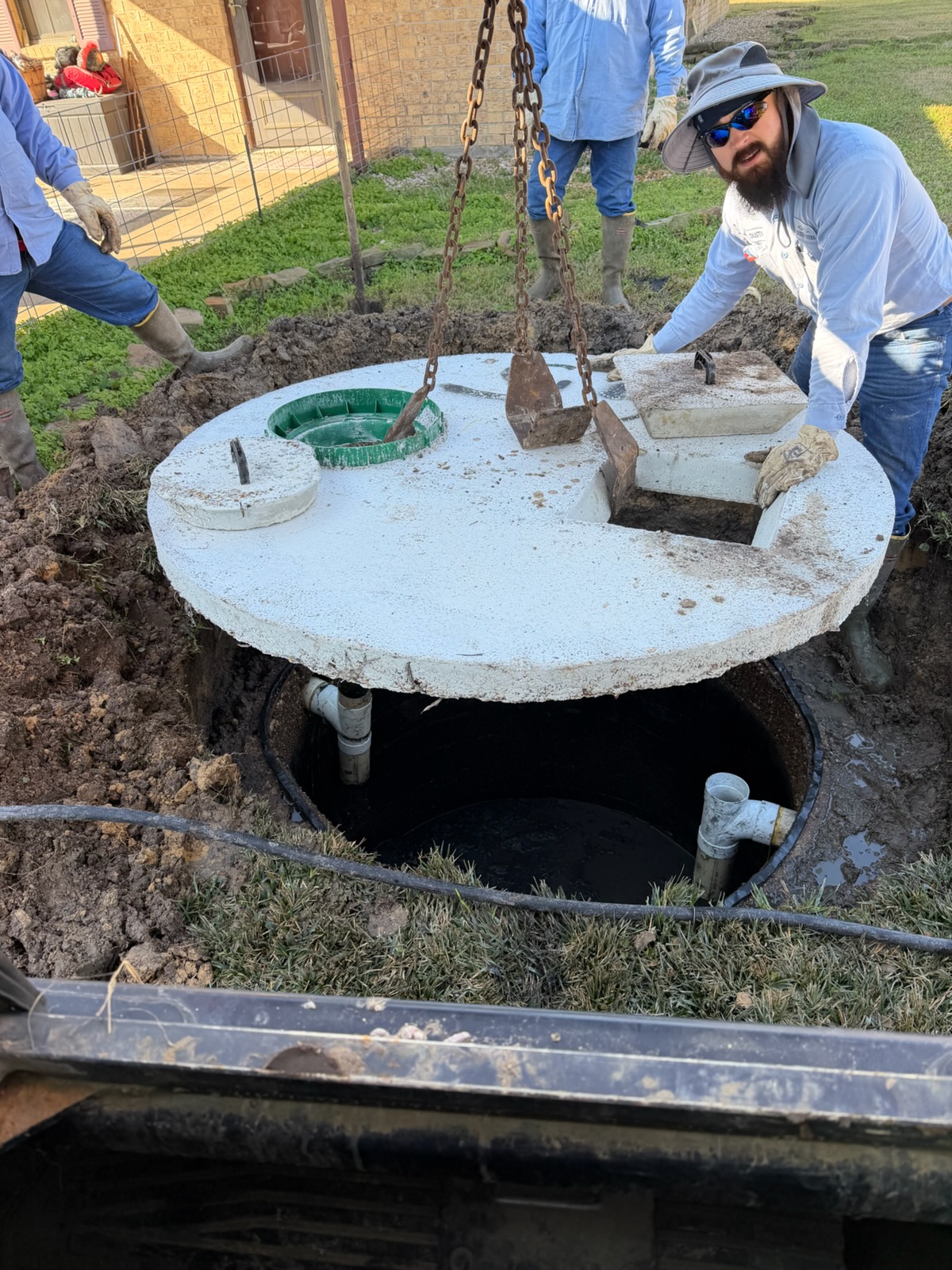
How a septic system works
No sewer line out here means your house treats its own wastewater, right in the yard.
Every sink, shower, toilet and washing machine in the house drains to one place: an underground septic tank. Inside, things separate. Heavy solids sink to the bottom as sludge. Grease and lighter material float to the top as scum. The liquid in the middle moves on to the next part of the system.
On many properties, that next part is a drainfield, a set of lines buried in the yard where the water spreads out and soaks down through the soil. Yours may be set up a little differently, and we're happy to walk you through it when we're out there.
Here's the part most people don't know: the solids in the tank don't drain away.
They keep building up. If the tank is never pumped, sludge and scum take up more and more room until solids get pushed out into the lines beyond it. That's when you see clogs, backups and soggy ground. Pumping and cleaning on a regular basis clears that buildup before it gets that far, and it's a lot easier on you than repairing what's downstream.
Signs your system needs attention
Notice any of these around the house? Give us a call and describe what you're seeing.
- Slow drains
- Sinks, tubs and toilets that take their time emptying, especially more than one at once.
- Gurgling pipes
- Bubbling or gurgling from drains or the toilet after you run water.
- Odors
- A sewage smell inside the house or out in the yard near the tank.
- Soggy ground
- Wet, spongy spots or unusually green grass over the tank or the drainfield.
- Sewage backups
- Wastewater coming back up into drains, tubs or toilets. Cut back on water use and call us.
What to expect on a service visit
Every yard is different, but a visit usually goes in this order.
-
1
Locating and accessing the tank
We find the tank and get to the lid. If it's buried, that means some digging to uncover it.
-
2
Pumping
The tank is pumped out to remove the built-up sludge, scum and liquid.
-
3
Checking the tank and its parts
With the tank open and empty, we look it over along with its parts to see how everything is holding up.
-
4
Advice on next steps
We tell you what we found, what it means for your system, and what we'd suggest from here. Ask as many questions as you like.
How often does a tank need pumping?
It depends mostly on two things: how many people live in the house and how big the tank is. A full house sends more into the tank every day, so solids build up faster. A smaller tank has less room before it fills. Water habits and what goes down the drains play a part too.
So there's no single schedule that fits every home. The dependable approach: have the tank checked regularly, pump it when the buildup calls for it, and keep a record of each visit so you can see the pattern for your house.
★★★★★
"I had a septic issue and they were incredible! They knew exactly what to do, explained everything clearly, and were extremely friendly throughout the process."
Common questions
How often should a septic tank be pumped?
It varies with household size, tank size and how much water the house uses. Regular checks tell you when it's time, so you're not guessing.
How can I tell if my tank is full?
Slow drains, gurgling pipes, sewage odors, soggy ground near the tank or drainfield, and backups into the house are all signs. Some tanks give little warning, which is another reason regular checks are worth it.
Seeing one of the signs? Let's talk.
Call us Monday to Friday, 8:00 AM to 5:00 PM, and tell us what's happening at the house.